
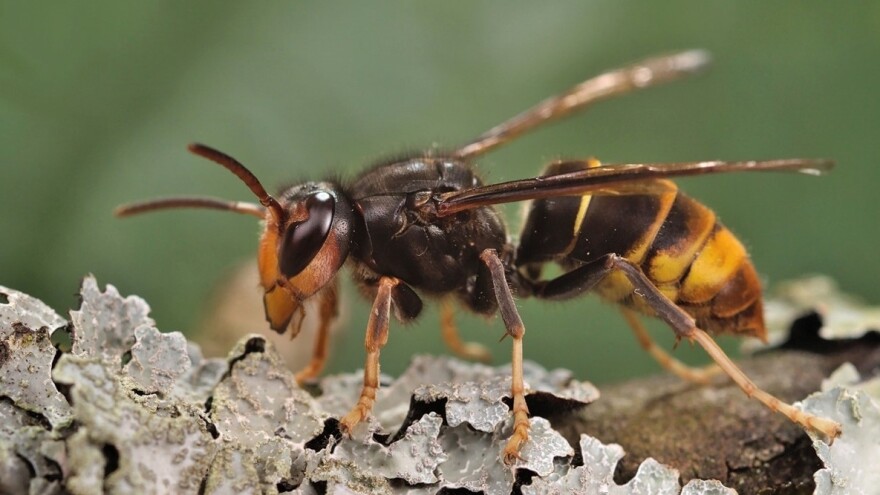
North Carolina agriculture officials have confirmed the state’s first established presence of the invasive yellow-legged hornet, a predator capable of threatening honeybees, native pollinators and agricultural production.
The North Carolina Department of Agriculture and Consumer Services confirmed the hornets were detected in Matthews near the Union and Mecklenburg county line.
The investigation began after a Union County homeowner noticed suspicious hornet activity around a hummingbird feeder and reported it to state officials.
More Than 200 Traps Placed
A follow-up survey found additional adult yellow-legged hornets in the surrounding area. State and federal agriculture teams are now working to locate and remove the nest before the invasive species can spread further.
More than 200 survey traps have been installed around the area where the hornets were observed. The response includes personnel from the North Carolina Department of Agriculture and Consumer Services and the U.S. Department of Agriculture.
Officials are also asking beekeepers and homeowners across North Carolina to watch for the hornets and report possible sightings.
Why the Hornet Is a Threat
The yellow-legged hornet, scientifically known as Vespa velutina, is native to Southeast Asia. It was first detected in the United States near Savannah, Georgia, in 2023.
The hornets prey on honeybees and other insects. They are known for a behavior called “hawking,” in which they hover near the entrance of a beehive and capture bees as they enter or leave.
Continued attacks can reduce a bee colony’s ability to forage for food and may eventually contribute to colony failure.
State Apiarist Don Hopkins warned that damage to honeybee colonies could reduce honey production and affect crop production by decreasing pollination from honeybees and native pollinators.
How to Identify a Yellow-Legged Hornet
Adult yellow-legged hornets are approximately one inch long. Their most recognizable feature is the yellow coloring on the lower portion of each leg.
The insect has a dark chest and an abdomen that is darker near the base and becomes lighter toward the tip.
Their nests can also look different from the gray paper nests commonly associated with native hornets. Yellow-legged hornet nests may have a reddish or muddy-brown appearance.
At this point in the summer, state officials said an active nest could be approximately the size of a volleyball. Mature nests can grow much larger and may contain hundreds of workers.
What Residents Should Do
Anyone who believes they have seen a yellow-legged hornet should not disturb or attempt to remove the insect or nest.
Residents are encouraged to take a clear photograph from a safe distance. Including an object such as a coin or pen in the photograph can help officials determine the insect’s approximate size.
Reports should include the location and date of the sighting, along with the observer’s contact information. Suspected sightings can be submitted through the yellow-legged hornet reporting tool provided by the North Carolina Department of Agriculture and Consumer Services.
Officials caution that several native wasps and hornets resemble the invasive species. A photograph allows trained specialists to confirm whether further investigation is needed.
The state’s current response is focused on locating the nest connected to the Matthews-area sightings and preventing the hornet from establishing additional populations in North Carolina.
Source: North Carolina Department of Agriculture and Consumer Services.